 how-to
How to Organize Daily Pills: A Step-by-Step Guide
Table of Contents
- Step 1: Build a Master Medication List
- Step 2: Match Your Dosing Schedule to a Pill Organizer
- Step 3: Set Up a Reminder System That Fits Your Day
- Step 4: Label and Color-Code Your Compartments
- Step 5: Choose the Right Pill Organizer for Travel
- Step 6: Store Medications Safely at Home
- Medication Adherence Tips That Actually Stick
- When Medication Packaging Services Make Sense
- Frequently Asked Questions
Last Updated: September 13, 2026
Step 1: Build a Master Medication List
A master medication list is a single document that records every prescription, over-the-counter drug, vitamin, and supplement you take, along with dose, timing, and the prescriber's name. It is the foundation of any system for how to organize daily pills, because you cannot sort what you have not accounted for.
Start with a simple table. Pull every bottle from every drawer, cabinet, and bag, then record:
- Medication name (generic and brand)
- Strength and form (tablet, capsule, liquid)
- Dose and dosing schedule
- Prescriber and pharmacy
- Refill frequency and last fill date
Keep one copy on the refrigerator and one in your wallet. Bring it to every appointment. This is medication reconciliation in its simplest form, and it is what prevents duplicate prescriptions and dangerous interactions. A pharmacist consultation can review the list for conflicts you may not see.
Step 2: Match Your Dosing Schedule to a Pill Organizer
Match your organizer to your dosing schedule, not the other way around. If you take a morning dose and an evening dose, you need a twice-daily organizer. If you take four doses a day, a simple weekly pill box will not work.
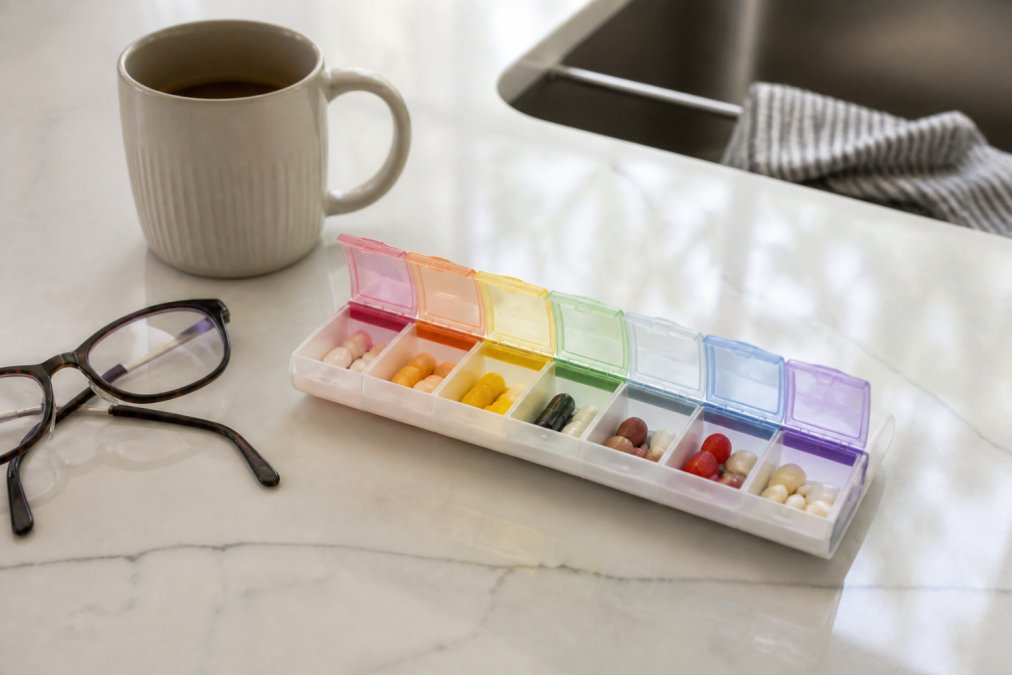
Weekly Pill Box vs. Daily Options
A weekly pill box holds seven days of compartments and works well for once- or twice-daily regimens. Daily options, including single-day organizers and blister packs, suit people who take several doses at set times or who travel often.
| Organizer Type | Best For | Main Trade-Off |
|---|---|---|
| Weekly pill box | Once- or twice-daily dosing | Hard to carry for travel |
| Twice-daily weekly box | Morning and evening doses | Bulkier on the counter |
| Single-day organizer | Complex multi-dose schedules | Must be refilled daily |
| Blister packs | Travel and adherence checks | Requires a packaging service |
Step 3: Set Up a Reminder System That Fits Your Day
The best reminder system is the one tied to a habit you already have. Pair your morning dose with brushing your teeth and your evening dose with dinner. Anchor beats alarm for most people.
Layer in a backup. A phone alarm, a reminder app, or a simple wall chart all work. Many people find that two cues, one habit-based and one timed, catch the doses a single reminder misses.
Step 4: Label and Color-Code Your Compartments
Labeling and color-coding turn a full organizer into a system you can read at a glance. Assign one color per medication or per time of day, then stay consistent.
A few approaches that hold up over time:
- Color-code by time of day: yellow for morning, blue for evening
- Color-code by person: useful when you manage pills for a parent and yourself
- Label each compartment with the day and dose in large print
- Mark high-risk medications, such as blood thinners, with a distinct color
If you use a weekly pill box, label the lid, not the base. Lids are what you see when the box is closed.
Make the System Readable, Not Just Colorful
Color alone fails for the roughly one in twelve men and one in two hundred women with some form of color vision deficiency, and it fails for anyone sorting pills in dim light (Color Blindness). Pair every color with a shape or a symbol so the system works without relying on hue. A common pattern is a colored dot plus a letter: M for morning, N for night, and a triangle sticker for anything taken with food.
Print labels in a large, high-contrast font. Black text on a white or light-yellow label reads more reliably than colored text on a colored background. If you use a label maker, choose the largest tape width that fits the compartment lid.
Build for Hands That Struggle With Small Lids
If arthritis, tremor, or reduced grip strength makes opening compartments painful, the labeling system should reduce the number of times you open anything. A few adjustments help:
- Choose a weekly organizer with snap lids that pop open with light thumb pressure rather than a prying motion
- Look for compartments with rounded, raised edges you can catch with a fingernail
- Use a daily organizer with removable pods so you handle one small container instead of seven lids
- Keep a rubber jar opener or a small non-slip mat nearby to stabilize the box
- Ask your pharmacist about easy-open, non-child-resistant caps if no children or pets are in the home
For anyone with low vision, a talking pill reminder or a container with an audible alarm adds a second channel beyond the label. For cognitive decline, simplify rather than decorate: fewer colors, fewer compartments, and one clearly marked location for the whole system.
Show Food and Interaction Requirements Visually
Most guides stop at time of day, but the instructions that cause the most trouble are the ones about food and other medications. Build those into the label itself:
- Use a fork-and-knife symbol for "take with food"
- Use an empty-circle symbol for "take on an empty stomach"
- Use a crossed-out grapefruit for medications that interact with grapefruit
- Use a small clock icon with a number for "wait two hours after" medications, such as thyroid replacement
- Use a distinct border color for anything that must not be taken with a specific other drug
Keep a one-page legend taped inside the cabinet door or stored with the organizer so anyone helping you, including a caregiver or an emergency responder, can decode the symbols. Update the legend the same day a prescriber changes a dose, and cross out the old entry rather than erasing it, so the change is visible.
A good labeling system does three jobs at once: it tells you what to take, when to take it, and what to take it with. If your labels only cover the first two, add the food and interaction symbols before you sort another week.
Step 5: Choose the Right Pill Organizer for Travel
A pill organizer for travel needs three things: it must seal, it must be compact, and it must show what you have already taken. Loose pills in a baggie fail all three.
Start by counting backward from your return date, not forward from your departure date. Add the number of doses you take per day, multiply by the number of days you will be away, then add a buffer of three to five extra days. Delays, missed connections, and weather cancellations are common enough that running out mid-trip is a real risk, and replacing a maintenance medication away from home is far harder than packing a few extra doses.
Match the Container to the Trip Length
| Trip Length | Best Container | Why It Works |
|---|---|---|
| One to three days | Single-day organizer with removable pods | Fits in a pocket or purse; refill is trivial |
| Four to ten days | Weekly pill box with AM/PM compartments | One sort covers the whole trip |
| Longer or multi-leg | Pre-sorted, date-and-time-stamped packets | Each dose is sealed and labeled; no daily sorting |
| Any trip with controlled substances | Original labeled pharmacy bottle | Keeps the prescription label and prescriber name attached |
For short trips, a small daily organizer with removable pods works well because you can carry only the day you need and leave the rest in your bag. For longer trips, pre-sorted packets are the simplest option, since each dose is already sealed and dated and you can tear off days as you go.
Carry-On Rules and Documentation
Carry all medications in your hand luggage, never in checked baggage. Checked bags get delayed, and a lost bag with your pills inside is a medical problem, not just an inconvenience. Keep medications in their original labeled packaging where required, and keep a copy of your master medication list with your travel documents.
If you travel with a controlled substance, keep it in the original pharmacy container with the prescription label intact. Some states and some carriers have specific documentation expectations, and a pharmacist can tell you what applies to your regimen before you leave. For anything injectable, ask your pharmacy about a travel letter and about how to carry supplies through security.
Temperature and Time Zones
Most tablets tolerate a normal carry-on environment, but a few need protection. Insulin, certain liquid suspensions, and some biologics need to stay cool, so use an insulated travel case with a gel pack rather than packing them next to a hot laptop or in a parked car (Insulin Storage and Syringe Safety). Check the storage guidance on the label before you leave, and ask your pharmacist which of your medications are temperature-sensitive.
Time-zone changes are the other travel trap. If you take a medication at a fixed clock time, shift your schedule gradually toward the destination time rather than doubling up or skipping. For medications taken at intervals, such as every eight hours, keep the interval rather than the clock time. Write the plan down before you fly so you are not doing the math in an airport.
Never mix different medications into one unlabeled compartment for travel. If a customs officer or emergency room physician cannot identify a pill, you lose critical time and information. Keep a copy of your master medication list with your travel documents.
Photograph your master medication list and your prescription labels and store the images in your phone. A paper list can be lost with a bag; a photo in your camera roll usually survives the trip.
Step 6: Store Medications Safely at Home
Storage conditions affect how well medications work. Most drugs belong in a cool, dry place, away from the bathroom's heat and moisture. The kitchen is often a better choice than the medicine cabinet.
Keep these rules in mind:
- Store away from direct sunlight and heat sources
- Keep medications in child-resistant containers where children or pets are present
- Check storage temperature guidance on the label for anything requiring refrigeration
- Keep pills in their original packaging until you sort them
- Review expiration dates monthly and set aside anything expired
For safe disposal of expired medication, use a drug take-back location or a mail-back program. If neither is available, the FDA advises mixing pills with an unappealing substance, sealing them in a container, and disposing of them in household trash rather than flushing, except for the small number of drugs it lists as safe to flush (the FDA).
Medication Adherence Tips That Actually Stick
Medication adherence comes down to removing friction, not adding willpower. The people who stay on track are usually the ones whose system requires the least daily effort.
What works:
- Refill on a fixed day each month, before you run low
- Sort pills on the same day each week, such as Sunday evening
- Track refill frequency so you notice a missed fill early
- Ask your pharmacist about pill splitting if a tablet is scored and a lower dose would help
- Review your full regimen with a pharmacist at least once a year
What does not work: relying on memory alone, keeping pills in multiple places, and skipping the review when a prescriber changes a dose. Most missed doses trace back to a change nobody recorded, not to forgetfulness.
When Medication Packaging Services Make Sense
Medication packaging services make sense when manual sorting has become a burden or a safety risk. If you manage polypharmacy, take medications from several pharmacies, or care for someone who lives alone, pre-sorted packaging removes the weekly sorting task entirely.
This is where Harpell Chemists comes in. MediPacket Premium is a pharmacist-curated packaging service that pre-sorts your medications, vitamins, and supplements into individual, date-and-time-stamped packets delivered to your door. Licensed pharmacists review your regimen, including oversight from George at Harpell Chemists, and robotically sealed packets reduce sorting errors. A monthly verification call catches medication changes before they cause a missed or doubled dose.
For caregivers, the packets double as a monitoring tool: one look at the strip shows whether doses were skipped. For travelers, tearing off a few days of packets replaces carrying multiple prescription bottles.
Pricing depends on the plan and quantity, and Harpell Chemists offers both an all-inclusive flat-rate option and an insurance-integrated option. Check the Harpell Chemists pricing page for current rates and free trial details.
Frequently Asked Questions
What should I look for in a pill organizer for travel?
Look for a compact, child-resistant case with secure lids that won't pop open in a bag. A weekly pill box with detachable daily pods works well because you can tear off just a few days' worth. Keep medications in their original prescription bottles when flying, and bring a copy of your medication list in case you're asked about your prescriptions at security or customs.
Is it safe to pre-sort medications into a pill box?
Pre-sorting is generally safe for most solid pills, but some medications degrade when exposed to light, moisture, or air. Ask your pharmacist whether any of your prescriptions need to stay in their original packaging. Also avoid mixing pills that look alike without labeling, and never pre-sort more than a week or two ahead unless your pharmacist confirms it's fine.
How can I keep track of vitamins and supplements alongside prescriptions?
Add every vitamin, supplement, and over-the-counter product to your master medication list, including the dose and timing. Supplements can interact with prescriptions, so bring the full list to your pharmacist for a medication reconciliation. Then sort supplements into the same compartments as your prescriptions so you take everything together as directed.
How do medication packaging services help with organizing daily pills?
Medication packaging services pre-sort your pills into individual, date-and-time-stamped packets, so there's no manual sorting and no guesswork. Each packet is labeled with the day and time, which gives you and your caregivers a clear visual check that doses were taken. Harpell Chemists' MediPacket Premium includes pharmacist review and monthly verification calls to catch any changes to your regimen.
Organizing daily pills is not complicated, but it does require a system you will actually maintain. Start with a master medication list, match your organizer to your schedule, and build in reminders that fit your routine. When manual sorting stops being reliable, Harpell Chemists can take it off your plate with pharmacist-reviewed MediPacket Premium packets, monthly verification calls, and delivery to your door. Secure your spot and enroll today.