 how-to
How to Verify Medication Adherence Remotely (2026)
Table of Contents
- What Remote Medication Adherence Monitoring Actually Involves
- Step 1: Choose the Right Medication Adherence Tools for Seniors
- Step 2: Learn How to Organize Daily Pills for Remote Verification
- Step 3: Set Up Remote Patient Monitoring Medication Adherence Systems
- Step 4: Build a Verification Routine with Automated Reminders and Caregiver Alerts
- Common Mistakes to Avoid When Verifying Adherence Remotely
- Frequently Asked Questions
Last Updated: September 27, 2026
What Remote Medication Adherence Monitoring Actually Involves
Remote medication adherence monitoring is the practice of how to verify medication adherence, confirming that a patient takes the right dose at the right time without a clinician standing in the room. It combines digital health tools, pharmacy records, and caregiver oversight to catch missed or doubled doses early. For families learning how to verify medication adherence remotely, the goal is simple: replace guesswork with proof. At Harpell Chemists, we see this question constantly from adult children caring for a parent across the country. (Source: a 2023 review in a peer-reviewed journal)
The old model relied on memory. The new one relies on data.
Why Visual Confirmation Beats Self-Reporting
People forget. They also misremember, and sometimes they stretch the truth to avoid worrying family. A 2023 review in a peer-reviewed journal noted that patients routinely overestimate their own adherence, which is why self-reporting alone is unreliable. Visual confirmation fixes that gap.
A date-and-time-stamped packet either exists or it doesn't. That single fact makes adherence visible at a glance.
National Library of Medicine research on medication adherence measurement
Step 1: Choose the Right Medication Adherence Tools for Seniors
Start with the tool that matches the patient's routine, not the fanciest option on the market. Medication adherence tools for seniors work best when they add almost no effort to the day. Three categories cover most households:
- Pre-sorted packaging for the simplest daily routine
- Smart pillboxes for patients who want digital reminders
- Video check-ins for complex regimens or high-risk drugs
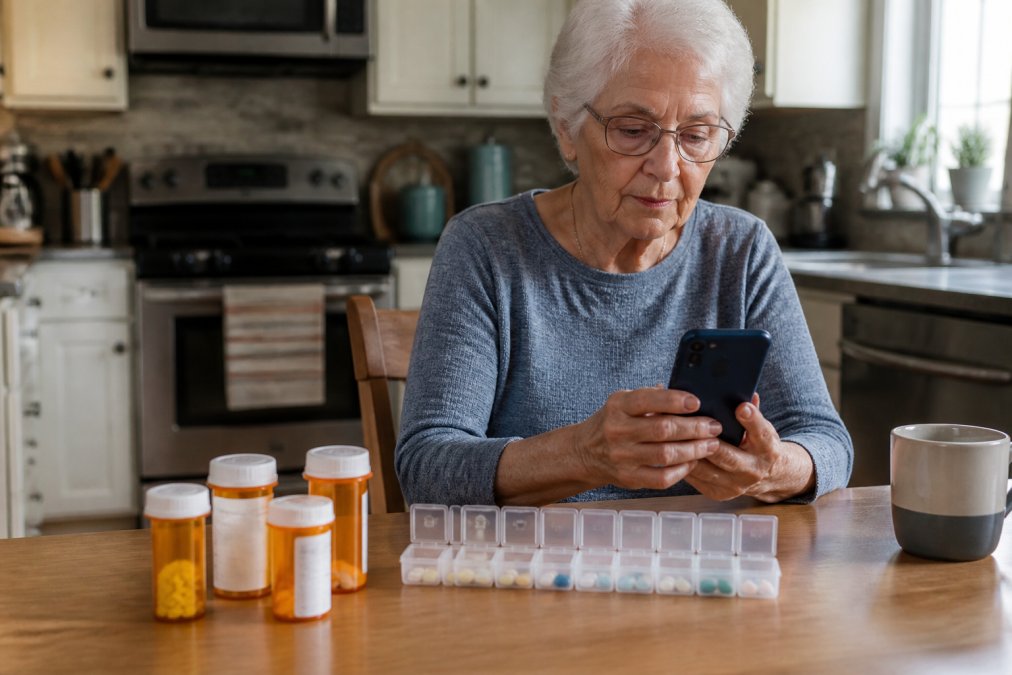
Smart Pillboxes and Sensor-Based Monitoring
Smart pillboxes use sensors to log when a compartment opens. Some send caregiver alerts if a dose window passes with no activity. They work well for tech-comfortable patients. The drawback: a sensor confirms the lid opened, not that the pill was swallowed.
Video-Based Observation and Telehealth Check-Ins
Video-based observation means a nurse or caregiver watches the patient take the dose on a live call. It is the most direct method, and it suits high-risk cases like blood thinners. It is also time-intensive, so most families use it for a few doses per week rather than every dose.
| Method | Confirms What | Effort Level | Best For |
|---|---|---|---|
| Pre-sorted packets | Packet removed on schedule | Very low | Daily routines |
| Smart pillbox | Compartment opened | Low | Tech-comfortable patients |
| Video check-in | Dose swallowed | High | High-risk medications |
Step 2: Learn How to Organize Daily Pills for Remote Verification
The core principle is one packet, one dose, one timestamp. When you know how to organize daily pills this way, verification becomes a glance instead of an audit. Set up the system so a missed dose is obvious.
- Sort by date and time, never by pill type alone
- Label each packet with the day and hour
- Keep one week visible at a time
- Store the rest in a single labeled box
- Note any "as needed" drugs separately
A pharmacist-curated packaging service handles this for you. MediPacket Premium from Harpell Chemists pre-sorts medications, vitamins, and supplements into individual date-and-time-stamped packets. With professional oversight from our licensed pharmacists, we ensure your dosing is accurate and safe, providing you with the peace of mind that you will never miss a dose again. You can tell at a glance whether a dose was skipped.
Step 3: Set Up Remote Patient Monitoring Medication Adherence Systems
A remote patient monitoring medication adherence system links three data sources: the patient, the pharmacy, and the care team. Set it up once, and it runs in the background. The pieces are straightforward.
- A verified packaging or sensor tool
- A shared dashboard or app for family
- A pharmacist who reviews changes monthly
- A backup contact for missed-dose alerts
Integrating Electronic Prescription Data and Pharmacy Records
Electronic prescription data tells you what was filled and when. Pair it with adherence data to spot gaps. If refills lag behind the schedule, the patient may be skipping doses. This is where medication reconciliation matters: a pharmacist compares every list to catch duplicates and interactions before they cause harm.
Secure Your Spot — Enroll Today →
Centers for Disease Control and Prevention guidance on medication safety
Step 4: Build a Verification Routine with Automated Reminders and Caregiver Alerts
A routine beats willpower every time. Set automated reminders on the patient's phone and caregiver alerts on yours. Then check the data on a fixed schedule, not randomly.
- Daily: patient takes doses from labeled packets
- Weekly: family reviews the packet box for gaps
- Monthly: pharmacist call to confirm no medication changes
- Quarterly: full medication reconciliation
MediPacket Premium includes monthly verification calls from licensed pharmacists, so changes get caught before they cause problems. George at Harpell Chemists provides licensed pharmacist oversight.
Skipping the monthly review is the most common mistake. A new prescription or a stopped medication can quietly break an otherwise solid routine, and nobody notices until a refill gap appears.
Common Mistakes to Avoid When Verifying Adherence Remotely
Trusting memory over records is the error that undoes everything else. Families mean well, but good intentions don't verify doses. Watch for these traps:
- Relying on self-reporting alone
- Using multiple pharmacies with no shared record
- Ignoring refill gaps as "just a delay"
- Never reviewing the medication list for interactions
- Assuming a sensor confirms a swallowed pill
A practical fix: pick one system and one pharmacist. Consolidation makes every other step easier. If you're managing polypharmacy, pharmacist-led oversight prevents dangerous drug interactions.
Verifying medication adherence remotely comes down to replacing memory with a visible record. That is harder than it sounds when three pharmacies, five prescriptions, and a busy schedule are involved. Harpell Chemists built MediPacket Premium to remove that burden: pharmacist-curated packaging, robotic precision into daily packets, monthly verification calls, and portable strips that travel as easily as a phone. Get started with Harpell Chemists and give your family proof of adherence instead of worry.
Frequently Asked Questions
How to check medication adherence?
Checking medication adherence remotely starts with a system that creates a verifiable record. Smart pillboxes log each opening, sensor-based packaging tracks when doses are removed, and pharmacist-curated packets like MediPacket Premium let you visually confirm whether a dose was taken by checking the strip. Combine one of these tools with periodic check-in calls or telehealth visits to confirm accuracy. The key is choosing a method that shows evidence, not just self-reporting, so you can spot missed doses early.
How is remote patient monitoring done for medication adherence?
Remote patient monitoring for medication adherence uses connected devices to collect data on when and how doses are taken. Smart pill dispensers, ingestible sensors, and electronic pill bottles transmit timestamped information to a secure platform. Caregivers or clinicians can review this data in real time, receive alerts for missed doses, and adjust intervention strategies. Always check with your provider about eligibility for coverage.
What technologies support remote medication tracking?
Common technologies include smart pillboxes that detect lid openings, sensor-based blister packs that register when a dose is pushed through, and digital pills with ingestible sensors that signal when swallowed. Mobile apps send automated reminders and log patient-reported outcomes. Video-based observation via telehealth lets a caregiver watch a person take their medication. Cellular connectivity ensures data transmits even without home Wi-Fi. Pharmacist-curated packaging, like MediPacket Premium, provides a low-tech visual verification method that works well for seniors and travelers.
How can I organize daily pills to make remote verification easier?
Start by consolidating all medications, vitamins, and supplements into a single system. Use a weekly pill organizer with clear compartments, or better yet, a pharmacist-curated packaging service that pre-sorts each dose into date-and-time-stamped packets. This eliminates manual sorting errors and gives caregivers an instant visual check: if a packet is still in the box, the dose was missed. For travel, tear off a few days' worth of packets instead of carrying multiple vials. Keep an updated medication list and reconcile it with your pharmacist monthly.