 how-to
Medication Packaging for Frequent Travelers
Table of Contents
- Why Medication Packaging Matters for Frequent Travelers
- Carry-On vs. Checked Baggage: Where Your Medications Go
- TSA Medication Rules: What You Need to Know
- How to Organize Daily Pills for Travel
- Pharmacist-Curated Medication Packaging: A Smarter Approach
- Managing Time Zones and Dosing Schedules Across Borders
- Documentation and Customs: International Travel Essentials
- Conclusion
- Frequently Asked Questions
Last Updated: September 20, 2026
Why Medication Packaging Matters for Frequent Travelers
Travel disrupts medication routines. Crossing time zones, managing multiple medications, and missing doses are common risks, especially for seniors managing chronic conditions. That's where medication packaging for frequent travelers becomes essential.
Medication packaging for frequent travelers solves this problem before it starts. Instead of carrying multiple prescription bottles, you get pre-sorted packets. Each packet is labeled with the date and time. You know exactly what to take, when to take it, and whether you've already taken it.
The solution isn't willpower, it's a system that removes the guesswork.
This guide covers everything you need to know about medication packaging for travel. We'll explain TSA rules, show you how to organize pills effectively, and introduce you to pharmacist-curated packaging options that eliminate the stress entirely.
Carry-On vs. Checked Baggage: Where Your Medications Go
Always pack medications in your carry-on bag, never in checked luggage. Checked bags get delayed or lost; carry-on bags stay with you.
Carry-on rules for medications:
- Keep medications in original containers when possible
- Pack them in an easy-to-reach section of your carry-on
- Store them in a medication organizer or toiletry bag
- Keep them at room temperature unless they require refrigeration
Checked baggage rules:
- Never pack temperature-sensitive medications
- Avoid checking medications if you can carry them on
- If you must check them, use an insulated cooler bag with ice packs
- Label everything clearly with your name and prescription details
TSA Medication Rules: What You Need to Know
The TSA allows medications in carry-on and checked baggage. You don't need a doctor's note or prescription copy, though having documentation is smart.
Key TSA rules for medications:
Liquid and gel medications follow the 3.4-ounce rule; insulin is exempt. Inhalers, EpiPens, and syringes with medication vials are permitted. Tell the TSA agent if you have medications, you don't need to remove them from your bag. Additional screening is routine and expected.
What counts as a medication under TSA rules:
- Prescription drugs in original containers
- Over-the-counter medications (pain relievers, allergy medicine, etc.)
- Vitamins and supplements
- Inhalers and nebulizers
- Insulin and other injectables
- Topical creams and ointments
How to Organize Daily Pills for Travel
Pre-sort medications before travel to save time and prevent mistakes. Options range from simple pill organizers to professional packaging services.
DIY pill organizer approach:
- Use a seven-day pill organizer with labeled compartments
- Sort pills by day and time (morning, afternoon, evening, bedtime)
- Fill organizers 2-3 days before departure
- Keep original prescription bottles as backup documentation
Portable medication packet method:
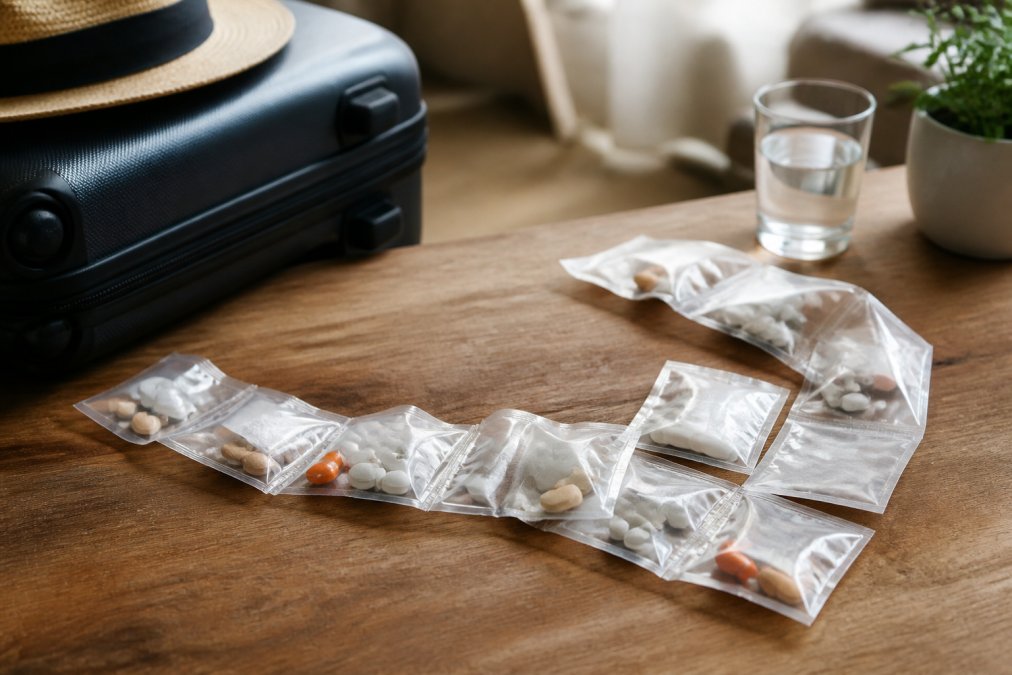
- Use small plastic bags or envelopes
- Label each packet with the date, time, and medication names
- Pack only the doses you'll need during travel
- Keep a list of all medications in your wallet
Travel medication kit assembly:
- Pack medications in a small toiletry bag
- Include a medication list with dosages
- Add over-the-counter medications (pain relievers, antacids, antihistamines)
- Include any medical devices (glucose monitor, EpiPen)
- Store in a cool, dry place away from sunlight
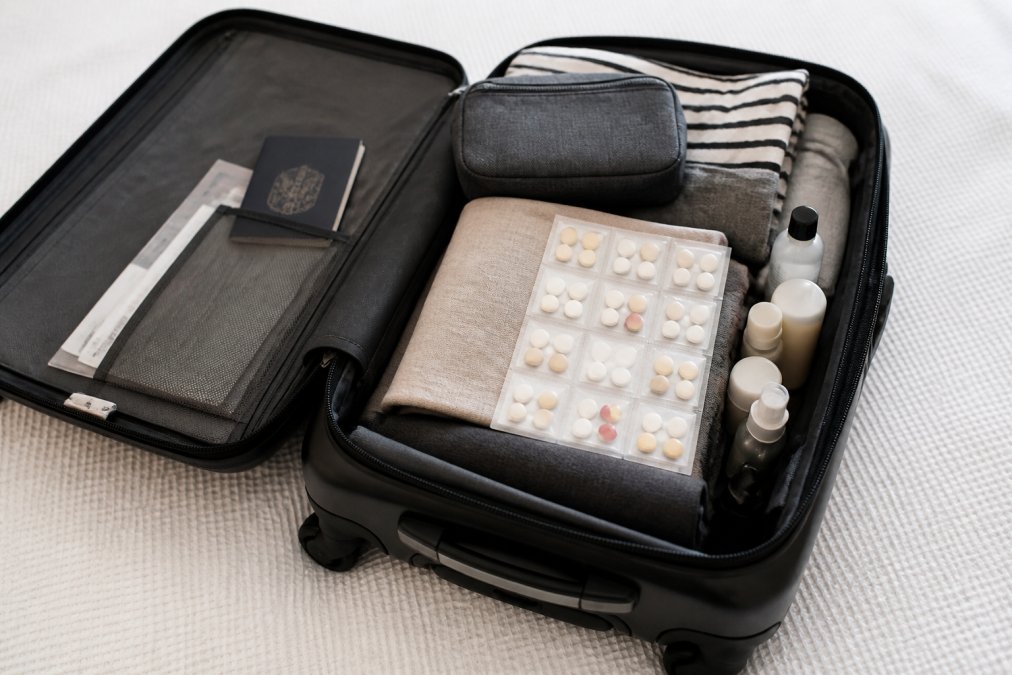
The key is visibility: glance at your medications and know immediately whether you've taken today's doses.
Pharmacist-Curated Medication Packaging: A Smarter Approach
Professional medication packaging removes the organizing burden. A pharmacist reviews medications for interactions and pre-sorts everything into individual packets.
How pharmacist-curated packaging works:
A licensed pharmacist reviews for interactions and correct dosages, then sorts medications into individual packets labeled with date, time, and contents. Packets are delivered ready to travel.
Harpell Chemists offers MediPacket Premium, a medication packaging service designed specifically for frequent travelers and people managing multiple prescriptions. Each packet is date-and-time-stamped. You tear off a few days' worth for your trip and go. No need to carry prescription vials. No confusion about what to take when.
Benefits of professional packaging:
- Clear visual verification of adherence (you can see if doses were taken)
- Elimination of manual pill sorting
- Pharmacist oversight prevents drug interactions
- Portable packets perfect for travel
- Reduced pharmacy trips and administrative burden
For seniors with complex regimens and busy professionals, pharmacist-curated packaging simplifies adherence monitoring and travel management.
Managing Time Zones and Dosing Schedules Across Borders
Time zone changes complicate medication timing. Adjustments depend on medication class, dosing frequency, and direction of travel.
Understanding medication-specific time zone rules:
Daily medications (blood pressure drugs, statins) are forgiving; missing a dose by hours rarely causes harm (pubmed.ncbi.nlm.nih.gov). Multiple-times-daily medications (insulin, antibiotics) require stricter adherence and precise recalculation. Time-sensitive medications (birth control) demand careful planning, taking a pill 12 hours early or late can reduce effectiveness.
Practical time zone adjustment framework:
Before traveling, work with your pharmacist to create a written dosing schedule for your destination. This should specify:
Secure Your Spot — Enroll Today →
- Whether to skip, delay, or take an extra dose during the transition
- Your new medication times in the destination time zone (written in both local time and your home time zone for the first 24 hours)
- What to do if you accidentally miss a dose
- When to resume your normal schedule after returning home
Digital tools and manual tracking:
Apps like Medisafe and Pill Reminder automatically adjust reminders to your current time zone, but complex regimens benefit from a pharmacist's written plan. Many frequent travelers use a simple phone note listing each medication, its normal time, and adjusted destination time.
Handling missed doses across time zones:
If you miss a dose, follow your pharmacist's written instructions. If you don't have them, contact your pharmacy. Explain your time zone, when you last took the medication, and when the next dose is due.
Jet lag and medication timing:
Continue taking medications at your pharmacist's specified times, even if out of sync with your sleep-wake cycle. For trips shorter than 3 days, keep your home time zone schedule to avoid confusion.
Documentation and Customs: International Travel Essentials
International travel requires additional medication documentation. Different countries have different rules, and proper paperwork prevents delays, confiscation, and legal complications.
Essential documentation for international travel:
Carry a doctor's letter listing all medications, dosages, reasons, generic and brand names, on official letterhead dated within 6 months. Keep prescription copies in your carry-on and photos in cloud storage. Carry a medication list in your wallet with dosages, frequency, and your doctor's contact information.
Customs declaration requirements:
Many countries require you to declare medications at customs. Some medications are restricted or prohibited in certain countries. Research your destination's medication rules before traveling, do not assume that a medication legal in the United States is legal elsewhere.
The U.S. State Department travel advisory database provides country-specific information about medication restrictions. The FDA guidance on traveling with medications explains what documentation you need.
Medications that commonly trigger customs issues:
- Controlled substances (even with a prescription): opioids, benzodiazepines, stimulants like Adderall
- Certain psychiatric medications: some antipsychotics and mood stabilizers
- Pain medications: codeine, tramadol, and other Schedule II or III drugs
- Medications containing pseudoephedrine (common in decongestants)
- Medications not approved in the destination country
- Large quantities of any medication (customs may question whether it's for personal use)
Emergency refill protocols: Lost, stolen, or damaged medication abroad:
Immediate steps if medication is lost or stolen:
-
Contact your U.S. pharmacy immediately, even if you're abroad. Explain your situation and ask whether they can arrange an emergency refill to be picked up at a pharmacy location in your destination country, if one exists.
-
Contact your prescribing doctor's office. Explain that your medication was lost or stolen. Ask whether they can send an emergency prescription to a pharmacy in your destination country, or arrange for a prescription to be held at your home pharmacy for when you return.
-
If you're in a major city, visit a local urgent care clinic or hospital. Explain your medical condition and that your medication was lost. A local doctor can sometimes provide a short-term supply of medication or a local prescription. This requires payment out-of-pocket and may be expensive, but it ensures continuity of care for critical medications.
-
Contact the U.S. embassy or consulate. They maintain lists of English-speaking doctors and can sometimes help you locate medical care. They cannot provide medications directly, but they can facilitate connections to local healthcare providers.
Prevention strategies:
International medication storage:
Conclusion
Medication management while traveling doesn't have to be stressful. The right system keeps you safe, organized, and on track with your health routine. Whether you organize pills yourself or use professional packaging, the key is having a clear, portable system before you leave.
Frequently Asked Questions
Can you pack multiple medications for travel in a single container or bag?
Solid medications (pills, tablets, capsules) in reasonable quantities can travel together in carry-on or checked baggage without individual containers. However, keeping original prescription containers is the safest approach for TSA screening and international customs. Pre-sorted medication packets with date and time labels work well for organized travel, but always carry documentation showing what each medication is. Liquid medications have stricter limits and must follow the 3.4-ounce (100 mL) rule per container.
What does TSA require for medication containers when flying?
TSA does not require medications to be in original containers, but original prescription labels make screening easier and faster. If you use pre-sorted packets or a pill organizer, carry a copy of your prescription or a letter from your pharmacist explaining what each medication is. Liquid medications, gels, and inhalers must be declared at security and follow the 3.4-ounce limit. Solid medications in reasonable quantities have no quantity restrictions, but customs agents may question large amounts, especially internationally.
How does pharmacist-curated medication packaging simplify travel?
Pharmacist-curated medication packaging pre-sorts your daily doses into individual, labeled packets organized by date and time. Instead of carrying multiple prescription vials, you tear off a few days' worth and pack them in your carry-on. Your pharmacist verifies dosing accuracy and checks for drug interactions before packaging, reducing the risk of errors. The clear labeling helps customs agents understand what you're carrying, and the organized format makes it easy to stay on schedule across time zones or busy travel days.
What happens if I need to refill my medication while traveling internationally?
Refilling medications abroad depends on local pharmacy laws and whether your medication is controlled. Before traveling, ask your pharmacist for an emergency refill protocol and carry extra doses as backup. Some medications are illegal or restricted in certain countries, so research your destination's regulations. Bring a copy of your prescription and medical documentation in case you need to explain your medication to foreign pharmacists or customs. Consider purchasing travel insurance that covers emergency medical expenses, including medication refills.